
The book metadata system we built for our own catalogue
Writing the book is step one. Then comes the launch metadata, and then the part almost nobody plans for: twelve months of having something to say about a book you finished writing months ago.
We were doing all of it by hand for every title we publish. Perivane is what we built so we would stop.
$99.99 a book, any length, delivered in a day.
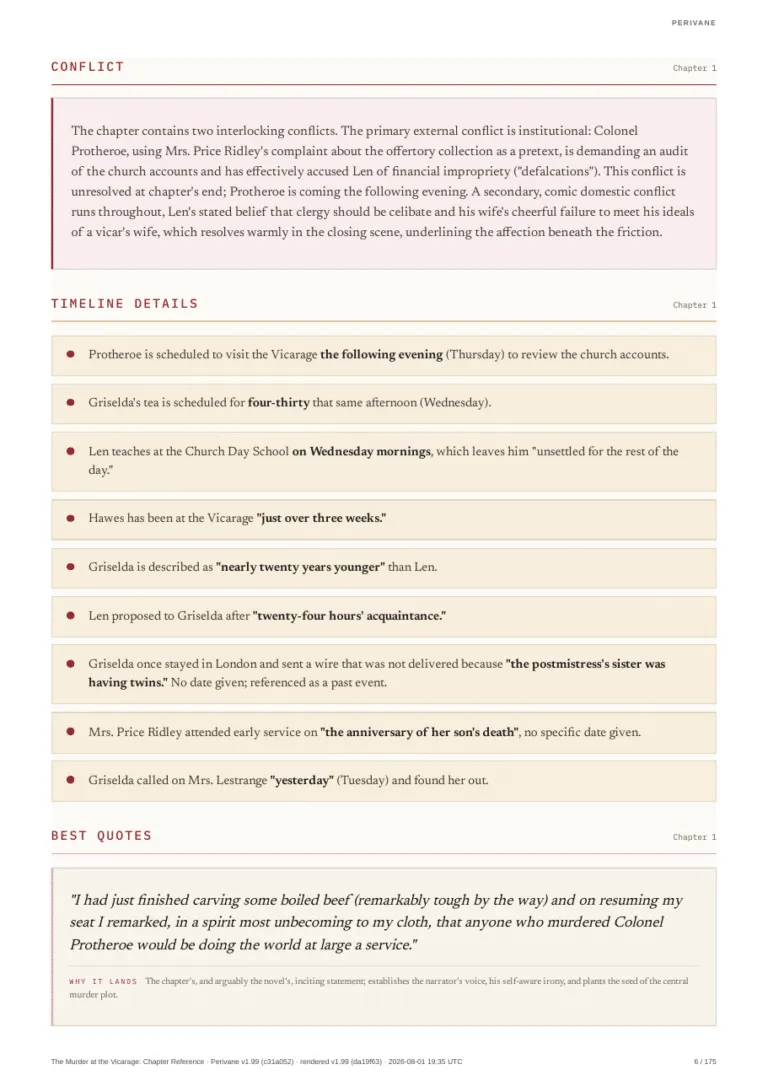
- 1Conflict. What the chapter is about, stated so it can be quoted in a pitch or a post.
- 2Timeline details. Every dated fact in the chapter, with the wording the book actually uses.
- 3Best quotes, and why. The lines worth sharing, each with a note on what it establishes.
The job nobody budgets for
Before the listing goes live, an author owes a pile of small artefacts, each of which has to be right: BISAC and Thema codes, Amazon browse categories chosen against the sales pace they demand, seven keyword boxes, comparable titles picked on audience rather than flattery, and a description that has to exist at four different lengths.
Then the launch happens, and the harder problem starts. The blurb is written, the ads are live, and there is nothing left to post. Marketing runs dry the week after launch, which is precisely when a book needs it most and when most authors quit.
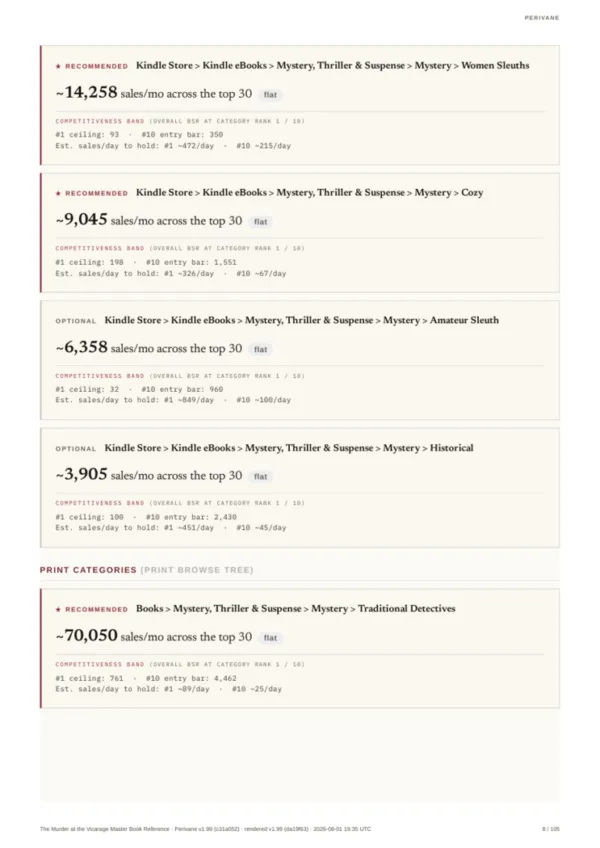
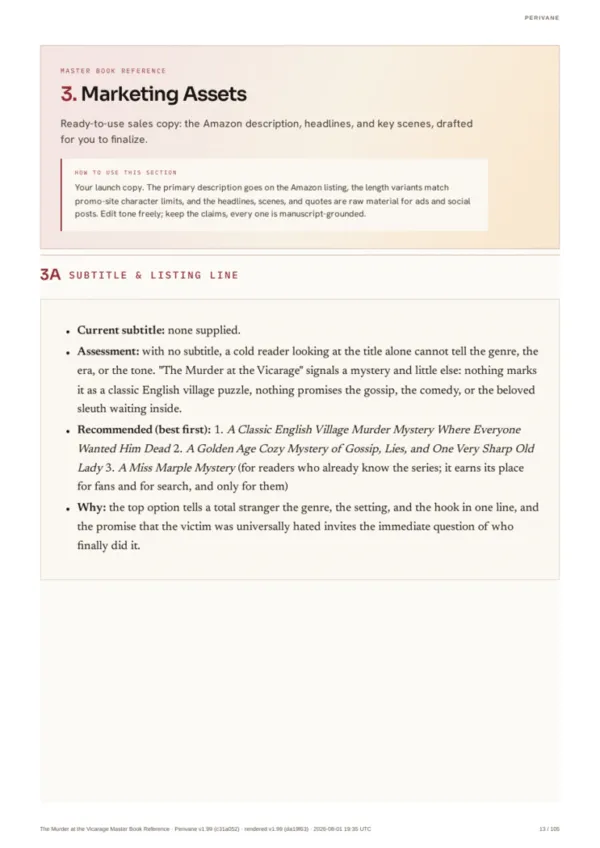
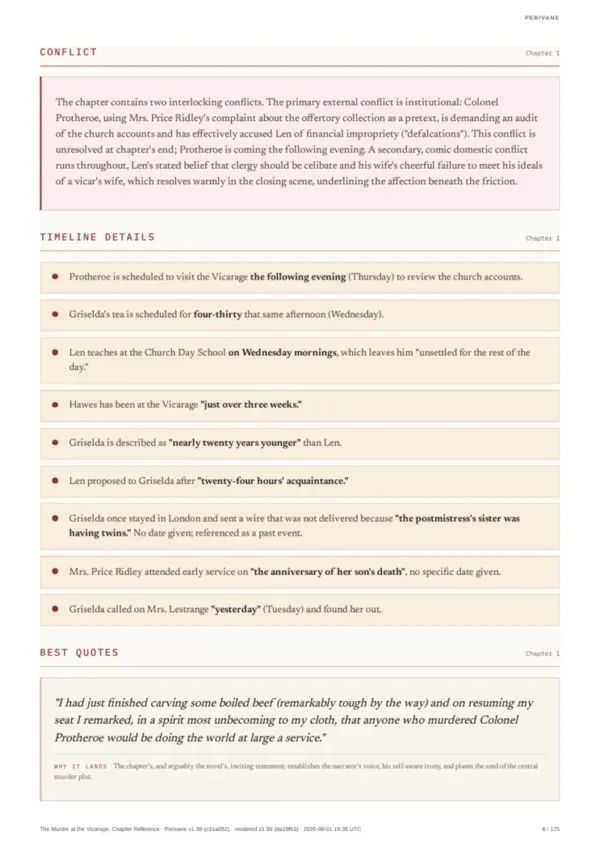
Plate II. Three pages from the published sample reports.The Murder at the Vicarage
Why we built it
Indie Pen Press publishes biblical commentary, speculative fiction and practical non-fiction. Three very different shelves, three different sets of conventions, and one person doing the metadata for all of them.
The tools we tried worked from a title, a blurb and store data. That is enough to guess a genre and not enough to tell a lay study guide from an academic commentary, or an adult novel from a young adult one. Those are exactly the mistakes that are expensive to reverse once a listing has history.
So Perivane reads the manuscript itself, and every recommendation it makes points back at the chapter it came from.
We ran our own catalogue through it first. On The Emotion Collector: Awakening it found four things a human read-through had missed: a central premise that contradicted itself across seven chapters, a supporting character under two different last names, two definitions of the same program, and a name ambiguity that changed the weight of a major character’s arc.
All four were fixed before printing. A contradiction spread across seven chapters survives every read-through by the person who wrote it, and a human editor reading in order does not see it either.
What it produces
One upload in, four documents out. Each ships twice: a typeset PDF for you and your editor, and a Markdown canon-pack for the AI you market with.
- 1
Master Book Reference
Eleven sections covering publishing metadata, classification, marketing assets, comp titles, reader persona and answer-engine entity data. The codes, categories, keyword boxes, subtitle recommendation and ready-to-use description all live here.
You reach for it: before you upload
- 2
Chapter Reference
The one you will use most. Every chapter mined for hooks, quotable lines, character beats and scenes worth filming. Quote cards, reel and trailer scripts, character spotlights, blog series, ad copy, book-club guides.
You reach for it: every week of the year after launch
- 3
Continuity Report
A whole-book read for trouble: a name that changes spelling, a timeline that slips, a term used two ways. It flags, you decide. It never rewrites your prose.
You reach for it: revision, and again before book two
- 4
Summary
The shortest one and the first you will use. Retailer metadata formatted for KDP and IngramSpark, blurbs in every length, a tagline, an elevator pitch and a one-page media sheet.
You reach for it: publish day
The report your AI can run all year
Ask a general chatbot about your book and it invents. It has never read the manuscript, so it fills the gaps with plausible detail belonging to somebody else’s novel.
The canon-pack is the fix. Every report ships with a Markdown version built from your actual text. Drop it into Claude, ChatGPT or Gemini and the model is working from your characters, your clues, your timeline. On canon by construction, for as long as you keep using it.
That is the difference between four finished files and a system that keeps producing.
You receive the documents, and you keep the source the documents were made from.
What it replaces
To get what a Perivane report contains, an author normally hires it out piece by piece, to four different people on four different schedules.
| What you are buying | Hiring it out | Perivane |
|---|---|---|
| Categories, keywords and comps | A metadata or keyword service$15 to $70 | Included, read from the text |
| Book description and blurbs | A blurb copywriter who reads the book$150 to $425 | Included, in every length |
| A whole-book editorial read | A manuscript assessment, 90,000 words$1,800 to $2,700 | Included, flagged for your call |
| A year of marketing material | An author social-content package$400 to $1,000 | Included, chapter by chapter |
| Turnaround | Four briefs, four schedulesWeeks | Within a day |
| Reusable afterwards | Finished files onlyNo | A Markdown canon-pack that keeps working |
| Total, one book | $2,365 to $4,195 | $99.99 |
Sources. Ranges are published 2025 to 2026 rates for a 90,000-word manuscript, drawn from Reedsy marketplace data and Editorial Freelancers Association guidance. Current pricing is on perivane.com.
Two worked examples, published in full
Both are public-domain books, and both sets of reports are published complete rather than as excerpts, so you can read what the output actually looks like before deciding anything.
The Murder at the Vicarage
Agatha Christie, 1930
Character bible, clue tracking, continuity flags, and a comp list with an exclusion for every title rejected on audience.
Read the Master ReferencePDF, about 6 MB
Expository Thoughts on Matthew
J.C. Ryle
Recurring themes, key figures and doctrinal threads that must stay consistent chapter to chapter. The source text of our own Matthew study workbook.
Read the Master ReferencePDF, about 5 MB
Perivane is our own product, and we sell it
One flat price per book, any length, no subscription. A series of three or more is priced per title and analysed in series context so book two never contradicts book one. Every manuscript is scanned for fit before anything is charged, and every report passes a human review before it is delivered.
Fiction, non-fiction and biblical titles each have their own prompt set. It never writes a word of your story: it reads what you already wrote.